
 Fax: 508-651-2674









Britt Andreatta’s Brain Science Tips
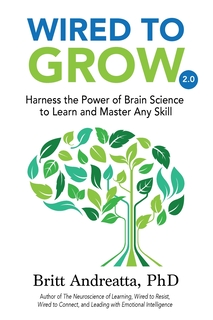
Huge thanks to Britt Andreatta for joining our recent Show & Share by Trainers Warehouse to share Brain Science Training tips from her book, Wired to Grow.
The following are top takeaways, drawn from both her wisdom and that of our seasoned training participants.
THE BRAIN ON LEARNING
Learning builds neural pathways — not just conceptually, but physiologically. When learning happens and gets repeated and repeated, those pathways get bigger and stronger. Researchers can witness this by having participants wear skull caps that show which regions of the brain are activated at any given moment, what neurological structures support learning, what neurons sound like when they’re firing, and how multiple networks of the brain work at once. It’s truly amazing what brain scientists have figured out about how we learn and grow. A few findings pop out to me as I think about the challenges for corporate trainers and talent development professionals:
- The 20 Minute Rule: Typically, we have 20 minutes of focus before our brains naturally tune out and need to turn to something else. As such, Britt suggest that trainers should:
- Structure learning days in 15-minute increments
- Introduce an exercise, break, or processing time, at least every 20 minutes
- Increase focus by making fidgets available
- Default Mode Network: This is the part of the brain that lights up when we let our minds wander. The network acts like an orchestra conductor. How to Change Your Mind by Michael Pollan
- Daydreaming primes the brain for Ah Ha moments
- Give their brains time to check out…
- Let Learners Experience Ah-Ha Moments on their Own: Research shows that Ah-ha moments physically transform the brain, making learning sticky. There are also “tells” in the brain when an ah-ha moment is imminent. The Eureka Factor by
- Ah-Ha moments are accompanied by burst of gamma waves above our right ear
- Ah-Ha moments often happen in the shower because the absence of visual stimuli (white noise and blank walls) prime our brain for those moments.
HOW TO INDUCE AH-HA MOMENTS WITH BRAIN SCIENCE TRAINING TIPS
As facilitators of learning, we can help individuals experience ah-ha by how we structure our sessions. For instance, we can:
- Introduce a range of topics without connecting all the dots. Let the learners do this! Resist being the “sage on the stage.” Consider “Deficit Learning.” That is, creating intentional gaps in understanding so that participants create those connections, or start inferring them before revealing the information later in a workshop.
- Dedicate blocks of time for reflection so participants can process, discover, and own their learning.
- Have participants actively apply the learning
- Give their senses a break — have them jot notes on a blank piece of paper, or look away from computer screens.
- Embrace SILENCE. Remember that silence gives others the space to think without having to digest continuous information. For online events, try the “waterfall” response approach in chat: time a minute or two of silence while people type/think, then everyone hits ENTER at the same time.
- Invite groups to develop stories that incorporate the concepts you’ve introduced. LEGO Activities for Training, has some great exercises for this.
- Use available tools like dry-erase boards, buzzers, etc., to make processing and reinforcement fun and different.
- Try role-play activities to apply concepts previously introduced.
- Don’t read your slides. Have participants form groups to digest, consider, or even critique the slide’s content together.
- Conduct a 3-2-1 recap exercise: Before they leave, have participants write down: 3 things learned, 2 they will apply, 1 to share.
- Remember the Mantra (and book by Marcia Tate) “‘Sit and Get’ Won’t Grow Dendrites.“
BEHAVIOR CHANGE AND HABITS
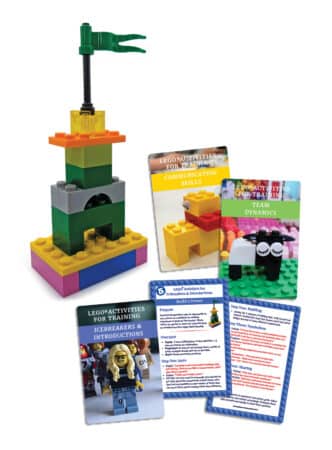
LEGO Activities for TrainingBUY NOW
We’re wired to do, to learn from others, and to grow and change. The brain structure most active in turning repeated behaviors into habits is the Basal Ganglia. Concentrating and learning something new requires a lot of work and energy in the prefrontal cortex, causing us to burn a lot of glucose (and get hungry!). After we’ve done that new thing for a while, our brain transforms it into a “low energy package” or habit, so it doesn’t draw so much energy. Research shows that a new neural pathway can begin to develop in as few as 20 repetitions, but it won’t transform into a habit until 40-50 repetitions. After 66 repetitions, the pathway begins to thicken.
In light of this, what can we facilitators do differently?
- Be sure that company executives understand the need for practice and repetition. If a workshop ends and participants simply go back to their jobs without using the material, the time will be wasted.
- Build repetitions into our training. Match learning offerings to the needs of the learners–do they need beginner-level exposure? Competency? Deep experience? Mastery? Read more here: The Power of Habit book.
- Engage in “Deliberate Practice,” where you aren’t just doing the same thing mindlessly, but you continue to grow using coaches, new goals, intense focus, and feedback. Read more in Peak, Secrets from the New Science of Exerpertise, by Anders Ericsson.
- Britt introduces a Process of Practice that start with a “Throw Away” where participants are encouraged to give something a messy first try, to get dirty, and expect to fail. After, ongoing practice attempts will help the learner to improve, hone, groove, and polish their skills.
- Combine in-class role-play or practice with breakout rooms, learning labs, observation, etc.
- Don’t try to do too much. Focus on what’s most important!
DESIGNING LEARNING – START BY ASKING THE RIGHT QUESTIONS!
“Engaging learning is born from the intersection of Discovery, Design, and Delivery.” ~Britt Andreatta
Don’t just say “yes” to any request for training. Rather, dig deeper with probing questions to understand the true needs. Say, “Tell me more.”
Britt generously offered to share the chapter of her book that focuses on “Asking the Right Questions.”
DOWNLOAD THE CHAPTER HERE: Britt’s Consulting Questions, OR PURCHASE THE BOOK FOR 25% OFF!
MORE RESOURCES
- For Eye Care: EyeCare 20 20 20
- For Avatar Practice Session:
- Synthesia.io
- HeyGen



PRODUCTS YOU’LL LOVE!

Easily "gamify" learning events